.jpg)

I have been hunting for stuff about Bob and have luckily found this recent talk he gave to Avalon Beach historical Society , on 22nd Feb 2014 . Below is a recent photo of Bob. He is a keen golfer and was president of the Avalon golf club for a while.

David Lyall, Geoff Searl and Bob Head (on the right )earlier this year . Photo by A.J. Guesdon
'My name is Bob Head – I moved from Gordon in 1944 to Newport and attended Newport Public School. I was a budding swimmer and used to go to The Spit everyday to train with a chap called Harry Hayes.
Life was good in those days, you could smell the freshly cut grass from the Victa mowers, everything was great. I joined the Newport SLSC at 12 years of age, got my 16 foot ‘Toothpick’ at 14 years of age. At 15 I moved to the Avalon SLSC of which I am a Life Member.
Having seen the film of Duke Kahanamoku visit and its life changing effect on the Surf Life Saving Community and surfing community last century, you would never believed that that could happen again, however, further innovative progress with surf craft went on at a steady pace until one day in 1956 when, for everyone interested in surfing, the world stopped and was never going to be the same again.
Having been in a couple of surf races at the Avalon Surf Carnival of November 18th, 1956, I was in the boat shed at the club with a couple of friends doing our end of carnival tasks. All of a sudden there was a deathly hush and we couldn’t work out what had happened, fearing at first that the worst had happened and there had been an accident. People were running past us, out of the boatshed, down from the sides of the surf clubhouse – we got drawn in and went out and had a look ourselves. There we saw something that we had never seen before – there were these chaps surfing across the beach – this way, then that way, back and forth – we’d never seen anything like it before. There is a photograph that shows those of the Avalon Surf Club who were in that carnival with the American surfers. I’m not in that photograph, and the reason I’m not in that photo is I ran home to Newport to ask my father for some money to build a surfboard. Not being the artists that David Lyall is, I knocked it up in a few days, took it down to Newport where it immediately sank and it’s still there somewhere. Such were my surfboard manufacturing skills at that stage.

From that day in 1956 on life changed, I use to go to swimming training, that stopped. Girls finished, Elvis was gone, there was a new language and the Beach Boys were on the radio, we were now talking about Okanuis, then Woodies – people didn’t know what we were talking about or understand what we were doing. Time went on and for some reason the clubbies and the surfers clashed, and I think it may have been more over safety and territorial issues, at any rate, the divide widened, especially with the Council’s introduction of registration of all surfboards which the surf clubs had a role in policing.
Being affiliated with both camps I decided I better try and do something about it. So along with Mr Sumpter ( Rod Sumpter's father Meryon who was Publicity officer for the Avalon surf club ) and myself we formed in 1958 what was known as a surfing organisation and started what was then known as the First Malibu Surfing Contest supported by Avalon Beach SLSC – this was certainly the first Malibu surfing contest run in New South Wales, if not within Australia. Over 200 surfers turned up that day, at which we were quite amazed. The following event was very successful - we had entertainers such as Col Joye presenting trophies and the contest was deemed to be an incredible success. At that time the other issues, as far as the Boardies and Clubbies were concerned, were put on the backburner. As Mr Ripley would say ‘believe it or not’ I was privileged to be a part of this Malibu phenomena happening again.
In 1962 I went to Newquay in Cornwall along with three friends, Warren Mitchell, John Campbell and Ian Tiley, taking two Malibu’s with us. We got jobs as lifeguards working on remote beaches outside the town.

Prior to our arrival some of these remote areas used huge army ducks to perform difficult rescues and these were what we initially used. These we found were not very practical. They had surf lines like we used here but on the occasions when you had nobody to pull you in if you were the lone lifeguard, they would fasten them to jeeps or vehicles and pull you in that way but they would get tangled when pulled over the landscape in this way.

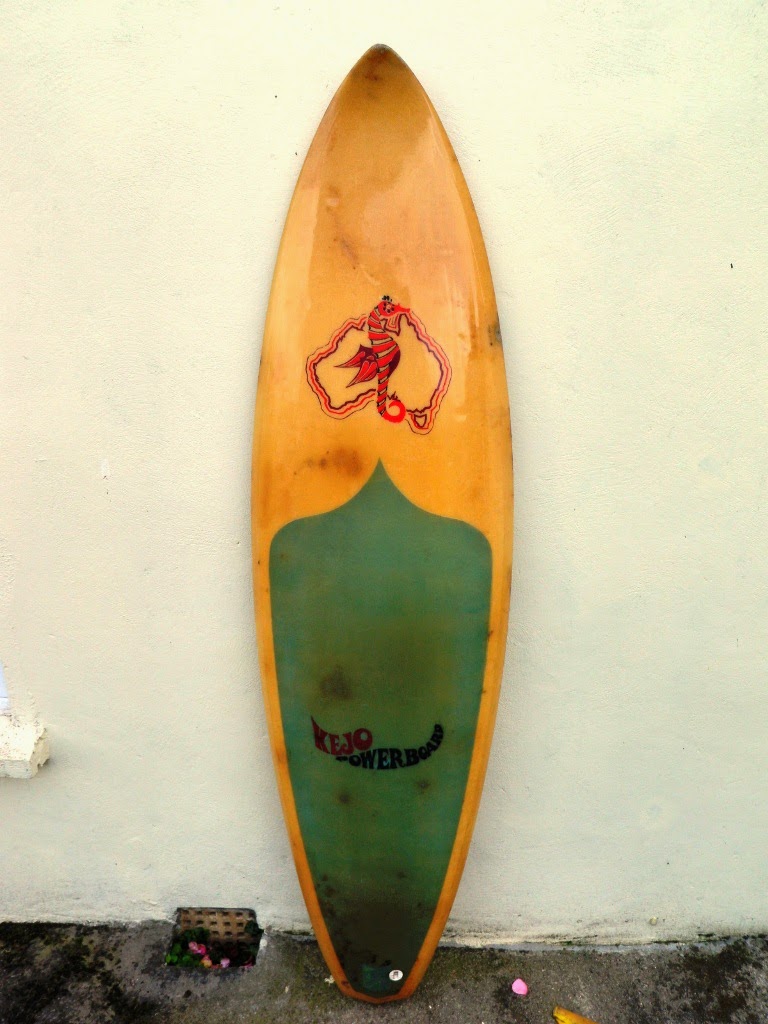
As we went there with double Malibu’s our rescue equipment of choice was these and we performed many rescues just using the Malibu. In this way everyone became aware of the boards versatility. In the previous year 16 people had been lost. In the years we were there nobody was lost. So this was quite a successful new piece of equipment from the life saving point of view. I would like to point out here that Warren Mitchell, a favourite son of Avalon, is the gentleman who is responsible for the rubber duckie. He said, when we were using the Malibu for rescues – “Bob we have to do something about this because we can only pick up one or two people” – as over there we at times would have to pick up not just one or two people, but half a dozen people, so Warren was always on the lookout for something different. That is where the seeds were sown for the rubber duckie. In our first overseas year off season we toured Europe – we went to Africa, Morocco, France – we surfed everywhere. We also experienced a huge demand for our boards and started making them (see article below). In the United Kingdom, in Cornwall in particular, this had a huge economic impact which before had been dependant on Tin mines and China clay.Surfing is now a billion dollar industry there.

When I first went to England I had to go by ship. Nowadays planes enable lifeguards to follow the seasons and many ex-Newquay people have ended up in Avalon. One of my early UK Malibu converts Mike Jones, has a son, Stanley, who is now Club Captain of Avalon Beach SLSC. To me one of the greatest achievements of the development of the Malibu is that it lead to the development of one of the greatest pieces of rescue equipment for surf life saving, that of Warren Mitchell OAM’s rubber duckie which has saved many many lives against all odds.'

"SURFIES" of CORNWALL by KERRY McGLYNN, in London for - Australian Women's Weekly magazine , 20 October 1965
Photos: below - BOB HEAD, from Newport, N.S.W., works on a surfboard. He set up the factory and shop at Newquay with three English partners and sells Malibu boards in England and on the Continent for well under half the price of the boards imported from America.

Below : Bob Newton, one of the Australians at Newquay, checks Malibu boards for hire on the beach.

Bob, from Balgowlah, N.S.W., has spent the summer as a lifeguard. The southern end of the beach was roped off with a warning: "For surfboards only." About a thousand yards out a little knot of board enthusiasts waited, their legs dangling lazily over the sides of multi-colored Malibus. They looked every inch the surfer: tanned, glistening young bodies, rainbow-colored Bermuda shorts, longhair bleached by the sun and probably just a dash of sink-cleaner. An everyday sight on Australian beaches. But these slaves of the surf were not within hotdogging distance of Manly or Bronte or Cronulla. THEY were at Newquay, on the coast of Cornwall, a quaint little English holiday town that was once a muted outpost of the deckchair and sun hat brigade, who looked on the surf as something to sit by, not swim in.
Their tranquil existence has been disturbed by an enterprising band of young Sydney surfboard riders who have turned Newquay into a surfing centre of Europe. The Australian surfing craze is rolling like a Bondi breaker across the pleasure resorts of Europe and North Africa. ….
Aga Khan: His instructors will be Sydney boardriders Rodney Sumpter, 18, of Avalon, and 23-year-old Dennis White, of Collaroy. This surf-mad pair left Australia in January for America, where they tried out their boards on the beaches of Newport, Rhode Island, after a stint in Hawaii. With money running short, they crossed the Atlantic to the island of Jersey, home of a big contingent of Australian surfies. There they took part in the British national and international championships in July.


Rodney Sumpter, a lean, lively English migrant who learned all about surfing in Sydney, took off both the national and international titles. Dennis, Sydney-born and bred, was not far behind, and finished fourth on points in the international contest. I spoke to Rodney at Newquay, where he and his blond-headed partner were preparing to leave for France to take part in the French championships. They were waiting for their Australian mate 24year-old Bob Head, of Newport, N.S.W., to finish two new boards for them.

Head, who has lived at Newquay for three years, is the one who has really cashed in on the European surfing boom. He arrived on the Cornwall coast three years ago with a Malibu board and landed a job as a lifeguard. At that stage, Malibu boards were as scarce in England as boomerangs.
Nobody at Newquav had ever seen one before. "A lot of people didn't even know that you had to take them into the water," Head told me. "They thought they were something to plonk on the sand and sit on. "The curiosity was tremendous at first, and it wasn't long before people started asking me to get them boards."
Within two years the small stream of orders trickling in has developed into a tidal wave. Two years ago Head made ten boards in 12 months. In the past month he has been turning out 20 a week. With three English partners he has set up a factory and a surfing shop in Newquay, and has made Cornwall as proud of its surf-boards as Liverpool is of the Beatles.
"The whole thing is spreading like wildfire," Bob Head said. "We have six people in the factory making surfboards, skateboards, and other beach gear. We have another six in the shop selling them, along with beachwear and all kinds of surfing books and trinkets.

On the Continent they've really gone for the boards in a big way. We have an agent who takes them all the time to flog in Europe. We met him about four months ago when we had a stand at the Boat Show in London. He looked our stuff over and took 50 boards on the spot."
Head, who was a sales representative in Sydney, had never made a surfboard before he came to England, and his first, effort was "a bit rough." He has one Australian working for him; this is Mick Jackman, a 25-year-old ex Sydney photo-engraver. The rest of the factory help are English. "Mick and I both used to hang around the board shops in Sydney, so we both had a pretty good idea," said Head. "But mostly it's been trial and error. Making surf-boards is a trade of secrets- every bloke has his own techniques and nobody is prepared to give his tricks away, so we have had to find out for ourselves.
We have suffered from a shortage of proper materials, particularly good foam, so our boards are not as good as the ones sold around Sydney." But to compensate, Head's company, European Surfing Co. Ltd., is selling its product at around £30stg. each(an American board costs about £70stg. in Europe).
How quickly are the British and Continental "gremmies" catching on? "I've been away four months of the past six in Britain and the Continent giving lessons, exhibitions, and demonstrations of all kinds," Head said. "There has been tremendous enthusiasm for board riding everywhere that I've been, and the youngsters seem to pick up the knack fairly well. They are probably a bit slower than Australians, but that's only natural, because they haven't had nearly as much opportunity as the kids back home." Head rates the Newquay surf the best in Europe "on its day." "The difference," he said, "is that in Sydney you can surf for maybe two-thirds of the year. Here you are lucky to surf for even a third of the year."
Head is the "elder states-man" - certainly the longest-established member-of the 15-strong Australian surfing community who live in Newquay. Five of these Sydney surf fanatics, Bob ("Nuts") Newton, 26, of Balgowlah, Gary ("Lumpy") Cox, 23, of Harbord, Warren ("Sui") Sullivan, 27, of Warriewood, Noel ( "Yokum" ) Harridine, 28, a former captain of Warriewood Surf Club, and Mick ("The Phantom")Irwin, 25, of Harbord, work as £14-a-week lifeguards on the beaches around Newquay. At nights they serve in a local pub pulling beer. Bob Newton estimates that he makes about £21st g.a week ("enough for a few beers and the birds").
Six of them live in a caravan park and spend all their spare time in the surf. Mick Jackman, known around Newquay as "Shades," earns extra money playing piano in a four piece band at a hotel. "I'm about to marry an English girl, so I need the money," he said. "I suppose I was earning about £2000 a year in Sydney as a photo-engraver. Now I'm ripping off about £33 a week with two jobs." Both he and Head are the permanent members of the Australian community, and plan to stay in Newquay for another five years. Head has married an English girl and has a baby son. "The Phantom" is also married. ("These English birds, mate, they are really great," explains Mick Jackman.)
The other Australians in Newquay work in pubs or on the beaches or both. They are the idols of dozens of Cornish school-boys, who have given up the Rolling Stones for the rolling surf. Said Dennis Holmes, "I've seen a few English 'gremmies' who look as though they will be real good on the boards." Rodney Sumpter agreed. "One kid I have seen is going to be a world champion." Sumpter and Holmes are off soon on their sponsored tour which will take them to Sardinia, the Canary Islands, Africa, and Singapore. "The Aga Khan has offered to put us up in his place at Sardinia for a while if we will give him lessons and demonstrations,” said Sumpter. "I reckon it's going to be pretty outrageous."
Phew that was a long blog post - but great to get some more info on Bob and the early days at Newquay , and a few more classic photos . I love the one of the hire boards at Newquay .