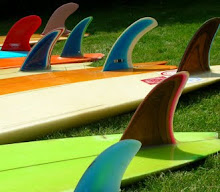
Vintage Surf meet 2019 coming soon !

Vintage Surf meet 2019 coming soon !
Free to take part
We buy interesting old boards 60s/70s/early 80s in good condition. Email alasdairlindsay75@gmail.com . Also wanted - Surfing UK , British Surfer and Surf Insight magazines .
Above photo - copyright Rennie Ellis photographer archive

Sunday, 20 January 2013

more spooning

A bit more about Hayden spoons. Gavin from Australia saw mine and sent in photos of his Hayden which also has the red velo design on. This ones a fully flexi spoon at the tail, with white pigment on the deck and underside so not a see through one. Its got a lovely Greenough fin, maybe mine would have been like this originally, just a bit longer at the base. This board will soon be in a british collection,  not mine, but it will be good to put them together and compare the differences. Gavin says - ''Mine is completely original, untouched and was bought new by the original owner in Rainbow beach circa 1968/9. Interestingly, he was a stand up rider who saw footage of greenough and wanted the feel that was happening with spoons. I have actually come across this a couple of times, where spoons have been owned by stand up surfers, rather than kneels''


George Greenough's name started to become well known in the surfing world when Nat Young won the worlds in 1966 on a revolutionary  9'4, thinner than most and with a flexible fin designed by Greenough. By the 1968 worlds all competitors boards had fins based on Greenough designs.
And Greenough's kneeboard surfing showed the Aussies that no matter how much they tweaked their longboards, they would never match the performance of GG's spoon. Thus started the shortboard revolution which eventually (many years later and after some dead end design phases) allowed stand up surfers to match GG's performance levels kneeling.
In the late 50s/ early 60s GG was making 5 ft long dished deck balsa kneeboards, originally twin fins but he found the closer he put the fins together the better it went so it became a singlefin, based on dolphin dorsal fins. His first spoon was Velo in 1965, a pure fibreglass shell which used the bottom of his balsa kneeboard as a mould. He shaped some leftover bits of foam for floatation at the rails and glassed them on, and ground the tail till it reached a desired flexibility under the load of a heavy turn. He now had an efficient straight rocker when he was planing, and a manouverable curved one when he was turning. This had never been seen before in a surfboard, and 40+ years later his spoons still stand as pretty advanced thinking.
Velo was barely able to float itself, and needed swim fins, or when GG had a camera ,an extra air mattrees for floatation to paddle out .It also needed good waves, fast and powerful. Once on a decent wave, it sat naturally in the pocket, and allowed George to go deep in the barrel, zip out onto the flat part of the wave and cut back into the white water with a conviction not seen before in stand up surfing. He blew minds, and was one of the few Americans the Aussies gave major respect to !
As most of you know, George's creativity went beyond just designing and riding the spoon - he made some great films including the Innermost limits of pure fun, Crystal Voyager and Dolphin Glide, designed and made windsurf boards, boats and a yacht, mat surfing, the list goes on.
 
In around 1965 George left his native Santa Barbara for a trip to Australia. He visited fellow American Bob Cooper who was working at Hayden Kenny's at Alexandra Headlands. Bob McTavish was also working at Hayden, and he and George soon became surfing buddies, especially at the newly found Noosa. McTavish and the Hayden shapers quickly got new ideas about how a surfboard could perform, and straight away copied George's narrow based fin based on a blue fin tuna. This soon became the world standard, but it started with George and then with Hayden.
In 1966 McTavish produced his first v bottom (around the fin area) on a 9ft board made for Hayden glasser Mick Hopper. By 1967 McTavish had moved down to Keyo in Sydney and was making v bottom plastic machines of 9 ft, the 8'6, then 8 ft , and the length kept dropping. They were the most responsive stand up surfboards ever made at the time. And so the shortboard revolution began. Within a year v bottoms had been dropped in favour of flat bottoms.
McTavish and George were still good friends and when Bob visited George in California they were the only two shortboarders in the US ; whereas back in Australia most companies were putting out versions of the new plastic machine design.
Rare twin fin Hayden spoon, only a few were made and most of these were exported to the US.
 The Hayden shop in 1965. The board with the white fin is Algie Grud's, and was the first conventional longboard to have a Greenough flex fin.
 Three generations of Greenough fins, 1962 from a balsa dished deck board, 1965 from the fibreglass Velo and a highly evolved mid 70s fin.

 George's favourite Velo (mk 2) above, and below how it was made by using the original balsa Velo as a mould, and then adding some foam offcuts around the rails.


Monday, 14 January 2013

Hayden spoon kneeboard

 I'm going to start off this year with one of my best finds from last year. It came about when a lady called Tiki emailed me with photos of this board. She had been clearing out her late father's garage in Sussex and had found this spoon at the back covered in a layer of dust. She wasnt sure where he'd got it, but guessed he'd bought it at a car boot sale or off one of his fishing buddies ,and was for him to play around on at the beach.
A quick type in of 'hayden kneeboard' to google and Tiki suddenly saw that this was an important board. Although she initially wanted me to sell it for her I finally was able to cut a deal with her for it, promising it would go to a loving household ! It still cost good money, but like - when is another of these going to come out of a garage in England ?!
After a few months of 'research' ,I am still stumped to the true history of this board, mainly because it isnt like any other Hayden spoon I've seen. Its a semi spoon, with foam all the way through to the tail , which Hayden made a few of - rarer, though possibly less desireable/ iconic than the  fully flexible Greenough spoons they made.
But what makes this board different, and earlier than those - are the diamond tail, v bottom and earlier greenough fin ( which has been cut or ground down at some point, either just after creation or in the 70s). This fin was based on the dorsal fin of a dolphin which George had designed in the mid 60s , whereas the usual fins on the Hayden made spoons are the very thin, tuna fin inspired Greenough designs of '68 onwards.
It has a deep displacement hull at the nose going into the v bottom which starts forward of the mid point, and has the two flat slabs which go right through past the fin to the tail. With the tail of this board not being flexible, the v bottom may have helped with the turning ability of the board, but would lose some of the straight line speed that the flat bottom spoons had. Apparently George Greenough tried a v bottom at one point but dropped it in favour of his flexi spoons. This Hayden copies the red pigment design of George's favourite Velo from 1965 .You don't see this design very often on the Hayden spoons, and it could be a link to how involved George was in the Hayden factory when it was made, which must be around 1967 ? Dimensions are 5'3 x 21'' , with the base of the fin 81/2 inches long.
Basically ,two big names come to mind when looking at this board. Obviously George Greenough iconic designer and the most progressive wave rider in the world in the 60s , and fellow revolutionary Bob Mctavish, the originator of the v-bottom ,and shaper of the shortboard revolution. And amazingly enough they were both working around the same factory in late 1966 - Hayden !
 So what is this board ? An experiment ? A design for less than perfect waves when pure spoons wouldn't work ? A custom for a heavier rider ? The answer must be out there somewhere. I have sent these photos to two of the major Aussie experts in spoons and Greenough and both of them have never seen a v bottom spoon before ,and say its something special, but cant pin any definite history on it. The guy I really need to ask is Terry McLardy, who made the spoons at Hayden (from around 1966 ) under designs and advice from Greenough himself.
''McLardy (who was taught to glass by Bob Cooper, sort of as an apprentice) made all the spoons, and says he figures there were about 200-300 produced. Hayden says 60-80. Since McLardy reckons he sometimes made a few a week, I'd go with his higher figure. McLardy worked for Hayden for nine years from late '65. Quite a few were sent straight to Hawaii, where Hayden had a deal to sell boards post-66.The design changed slightly, with the foam in the rails extending right to the tail in some, or ending quite a way up the board in others (I've no idea which shape came first). McLardy says he made them bigger or smaller depending on the size of the rider, just like a normal board. Most were about 5ft 6in, some 5ft 4in, some 5ft 8in. Also, some weren't totally scooped out. He has no recollection of ever making the twin-fin one which was auctioned in Hawaii, but is an easy-going chap who says he supposes he must have made it. What he does remember is making just one finless example, with a concave tail to compensate, and he says it actually worked. It was stolen from the beach one lunchtime. Now that would be the one to find.''
From Stuart Scott, author of 'Noosa - Surfing the 60s'
 
Stuart asked a friend about the board and came back with this -
 
''Well, my friend who in theory knows everything about Hayden spoons agrees that you've got something rare. He's never seen a V-bottom before. He agrees with my guess that it's presumably 1967, due to the V, or maybe 1968. And it's also long -- my spoon is 4ft 9 1/2, and I'm told the actual "Velo Mk 11" was 4'10'. He says: ``This has been coloured to resemble it. It would certainly be an early one ... Nice to see such an unusual board turn up after all these years.
It presumably was made by Terry McLardy . He once told me that he made the spoons different lengths depending on size/weight of the rider, just like shaping a regular board. And if he left all that extra foam in, maybe it was made for someone who really needed lots of flotation? Or maybe it was just an experiment? When you think of it, actual surfboards became shorter than that just a couple of years later.''


'And a spoon story which will break your heart: I remember the time when a very, very early one made by Greenough himself sat in Hayden's shop with a ``for sale'' sign on it for month after month, getting dustier. Would have been '65-66, and no-one wanted this silly-looking thing which was the same price as a new board then. It was an ugly drab green colour, like the boards Hayden made briefly. Its price kept being reduced, and after many months, one day it just wasn't there. Don't know if someone bought it or they threw it out. Hayden doesn't remember it at all.' Stuart Scott


George with one of his solid balsa kneeboards, which he used as a mould for laying the glass over to produce the flexible Velo .
George's favourite mid 60s Velo is top, with one of his recent graphite edged boards.
Laying it on the rail, Australia 1967
v - bottom test pilot McTavish, 1967
 
There is basically a load more information about the background behind this board , George Greenough and Bob McTavish that I think I'll do another blog post about it to keep this one from being massive. So that will come soon...
 
Thanks to Henry, Stuart and various Surfers Journals for helping me gather stuff for this post and the next.
If you know anything about this spoon please let me know, or if you own a British spoon send in some photos ! We already know a few were made by Tigger Newling, Tris, Tiki, and possibly Freedom and Bilbo.
 
 
The Hayden with Pete's and Henry's Farrelly spoons at last septembers surf meet. Henry's spoon - the purple one - was found in the UK.

Sunday, 13 January 2013

Alex Williams' 80s photos

Carwyn Williams, Lacanau 1988

Alex has been putting more of his huge archive of images online, and here are some classic shots from mainly 1981, '84 and '89. Seems like the sun shone brighter back then ?
Classic waves, boards and surfers .It would be great to have a big colour book of Alex's photos come out one day.

Cheyne Horan, fistral 1984
Dave Pearce
Dean Winter 1989
Derek Deer, Penhale 1989
Derek Hynd, fistral 1981
France 1990
John Copley, constantine 1989
Pottz fistral 1984
Mike Newling (Tigger's brother) and Joey Buran ,fistral 1984
Mike Raven, Fuerte 1986
Rob Erskine, Boobies 1988
Rudy Ski ,France 1990
Shaun Tomson, fistral surfmasters 1981
Tom Curren , France 1981
Nigel Veitch 1989
Rob Erskine, constantine 1984
Thanks to Alex.

Thursday, 10 January 2013


2007 Burleigh heads single fin classic, and here below is a link to this years one -
http://vimeo.com/56858618

Wednesday, 9 January 2013

boards for sale

Happy new year everyone ! If you've wondered why I've been so quiet lately, well I've been on holiday and then the mrs bought a new touch screen computer, so I've been struggling to learn how to use it . I am still a technophobe, even with three blogs and a website .
A couple of boards have come up for sale over Christmas. The first one is this John Hall singlefin from the early 70s, one of his early shapes before he got fully involved with shaping for Tiki. It was made in north devon and has a bennett foam decal. Looks in pretty good shape, theres been some work around the fin and the colour on the underside. Rare board though; for dimensions and offers email isaynicecheese@gmail.com .


This early 70s Gordon & Smith from the US is in really nice condition and in Camborne, Cornwall. Its 6'6 long and looks hardly surfed. It probably wouldn't have had a leash plug when made, but apart from that its a nice original board. Couple of repaired dings. Email offers to jpcr21@hotmail.com